
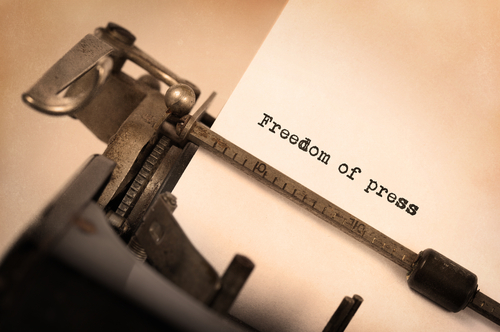
 Photo: MyImages – Micha/Shutterstock.com
When journalism is compromised, truth becomes the first casualty – and without truth no society can progress meaningfully, argues Laiq Ahmed Atif
Source: Times of Malta 15.09.2025 | Laiq Ahmed Atif | amjmalta@gmail.com
I would like to congratulate Times of Malta on its 90-year journey in Maltese journalism. The recent conference celebrating this milestone was a testament to the newspaper’s enduring legacy and I had the pleasure of attending and learning more about its remarkable history and its contribution to society.
My own journey with the Times of Malta began in 2007, first as a reader and, later, as a humble contributor. Over the years, I have come to deeply appreciate the profound impact journalism can have – both positive and negative – depending on how this powerful medium is used.
To me, journalism is not just a profession, it is a sacred responsibility. When practised ethically and with integrity, journalism can inspire individuals, uphold truth and human values and strengthen the fabric of society. But when misused or manipulated, it can harm individuals, polarise communities and destabilise nations.
Journalism is an excellent means of bringing people closer and has the power to build bridges, promote social harmony, build positive narratives based on love, compassion and solidarity and serve the greater common good. To my understanding, the first duty of journalism is to serve humanity by providing accurate, reliable and factual news and by building knowledgeable and harmonious communities.
One of the key reasons some nations struggle, or decline, is the denying of the freedom of speech and expression and erosion of honest journalism, replaced by dishonesty, bias and sensationalism. When journalism is compromised, truth becomes the first casualty – and, without truth, no society can progress meaningfully, and no nation can remain united.
Today, besides the print and electronic media, social media has become a dominant channel for sharing news. While it offers speed and reach, it also comes with serious risks of spreading fake news, misinformation and disinformation. Very often, unverified stories are circulated without research. This race for breaking news and attracting large viewership sometimes results in damaging reputations, inciting fear and, sometimes, even violence, and distorting facts. This is where timeless ethical principles of journalism are more important than ever.
When news appears on social media, people still turn to Times of Malta for verification– Laiq Ahmed Atif
The Holy Prophet Muhammad provided a profound principle that resonates in our time and it can be a guiding principle in the current era of social media: “News is not like seeing it for oneself.” This means that hearsay is not equivalent to eyewitness experience. If every journalist and social media user were to keep this in mind, much of the fake news could easily be prevented.
He further said: “The one who is present sees what the absent does not.” This reminds us that not only facts but also context and the way in which news is presented are profoundly important.
While social media may seem to challenge traditional journalism, the value of credible, sustainable, well-researched and professionally edited news remains unmatched; and its importance cannot be ignored. As highlighted in the Times of Malta conference, when any news appears on social media platforms, people still turn to Times of Malta for verification, authenticity and accuracy.
Therefore, traditional journalism’s importance will continuously remain intact; and public trust will eventually return to traditional journalism because people are growing weary of the noise, confusion and manipulation often found in unchecked online content.
Journalism will survive and must survive this era of uncertainty and attacks on the truth, not for the sake of jobs or institutions but for the health of democracy and for the greater good of humanity and its well-being.
We must commit to ensuring that journalism is rooted in research, free from exaggeration and driven not by profit or ratings but by a deep commitment to truth and service to humankind.
It must rise above lies and biases and embody the values of truthfulness, integrity, fidelity, impartiality and accuracy – for these are the soul of sustainable journalism. It is these core principles that will preserve the dignity of this noble profession, allowing journalism to remain a force for good, even in times of attacks and uncertainty.


 Ahmadiyya Muslim Jamaat Malta